This book purchase was recommended by a tutor from the previous module. The book complies of 15 Japanese artists and their visual response to Japan’s earthquake, tsunami and nuclear power plant meltdown of March 2011. It was curated by Anne Havinga & Anne Nishimura Morse and organised by the Museum of Fine Arts, Boston.
The Director’s Foreword says “Photographers were among the first artists to respond to the triple disaster. Some were drawn to the affected area in Tōhoku because they lived in the region or had once called it home. Others took the risk of entering the contamination zone around Fukushima plant. And some remained at a distance, making evocative images from their studios in Tokyo. The rich selection of photographers assembled in this book, and in the exhibition it accompanies, addresses universal themes such as the importance of place, humans versus nature, memory and loss, and nuclear anxiety’. (Malcolm Rogers, 2015, p7)
This is the first time I have looked at artists who have captured the aftermath of a natural disaster, but of course it’s not just capturing the aftermath but their response to it. The book features work not just relating to the landscapes that were involved with this disaster, but also works created in the studio which could offer a great perspective on how other artists respond to such an event. For my contextual research though I will focus on the artists that place their practice within the landscape of the affected areas. By reading over the introduction I could see already that some themes could relate to my practice, but it will be interesting to see how these artists respond to the aftermath but also documenting time as the area is regenerated and moves on after the disaster, and it is this idea of ‘moving on’ I am mostly interested in for this module.
Naoya Hatakeyama
This section of the book presents 15 images by Hatakeyama, there is also a small induction that engages with the viewer. The viewer contemplates what the Tsunami did to the memories and the past landscape and how it desperately tries to regenerate itself for a new future. The images are in chronical order from just after the disaster to the reconstruction process. On first encounter of these images they evoke a great stillness, you scan over the image and focus on the debris that has marked and peppered the landscape. In contrast to the subject they are quite beautiful and have been framed in a way that is pleasing to eye, you notice colour, texture and shapes. Although to view the first image to the last looks a little different, I’m not sure what it is but I feel I am looking in at this disaster at the start and towards the end I feel I am in the scene. I investigated further and found a YouTube presentation by Hatakeyama titled Personal Landscapes and was for the Museum of Fine Arts, Boston. https://www.youtube.com/watch?v=n2cWH_XJ5oQ&feature=youtu.be
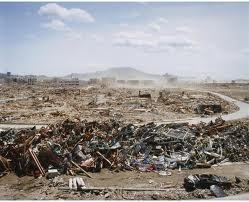
https://theimageflow.com/photography-blog/natural-stories-by-naoya-hatakeyama/
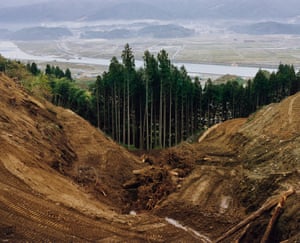
This was a very interesting presentation and has given a different perspective in viewing these images. Hatakeyama gave an in-depth background and contextual reasoning to his approach and the influences that made this body of work. Hatakeyama explains how he resides in Toyko but visits his family home in Rikuzentakata regularly, when the Tsunami hit, he returned to photograph it. He then goes on to explaining how this is a personal to him as he is a part of the event having his hometown destroyed by the Tsunami. However, as he was not actually living at his hometown when the tsunami hit, he didn’t experience the loss of house and personal possessions (although he lost his mother which I think is bad enough) the local government did not grant him a disaster victims certificate and instead saw him as outside the disaster. Hatakeyama says “At such times I wonder about the scope of the disaster like this. I might think I was within this event, but someone will tell me no you’re on the outside. I resign myself to that, when someone else would sympathise with me and say it must have been hard on you. I have referred to being on the outside and within the event but the boundary between the outside and within sways widely depending on the circumstance of who you are talking to and on the distance.” (Museum of Fine Arts, Boston, April 2015)
Hatakeyama then goes on to explain how this body of work cannot be called a project nor be critiqued, it is not boring, interesting or beautiful it is a response to a disaster, he says “response coveys a deeper truth then the word project” (Museum of Fine Arts, Boston, April 2015) Hatakeyama finally goes on to say as he continued to return and capture his hometown, as the regeneration and construction takes place he feels like this work is becoming less and less personal and often reminds him of his earlier work of lime stone mines.
After watching the presentation, I can see how his personal connection to the landscape sways for him and I have never thought about a photographer in that position. I can very loosely see that in my work, last module I wanted to discuss my personal journey and the concepts that influences my practice. The subject I capture mainly means I’m on the outside of the event but some elements such as being in the military then bring it back to capturing something personal (I hope no one is offended by this loose analogy). I have never really thought about the audience’s moral response to these photographs, critiquing them, interesting or not interesting is that appropriate to do so? Like it or not his images do have elements of aesthetics like for instance with in the colours of the sky, clouds, the framing of the image which is what I mentioned at the start. However, I think he does have a point I will be sure to question all of the context before concluding a critique of work.
 Critical Research Journal