This article featured online on the Places Journal with imagery by Mark Klett https://placesjournal.org/article/the-half-life-of-history/
I was interested in this article for mainly for the concepts that Fox talks about. I enjoyed looking at imagery by Mark Klett but visually I don’t think it adds perspective to my approach.
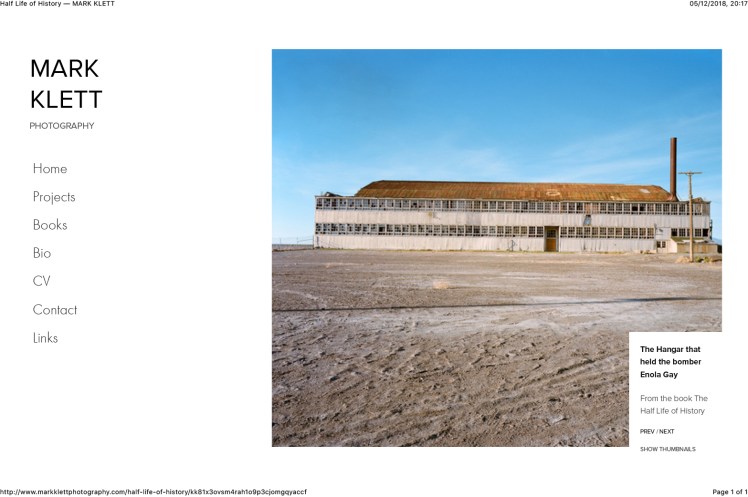
The imagery and article is about Wendover military Station, where the U.S Air Force trained for the bombing of Hiroshima. The main attraction to this site is the Enola Gay Hangar, which housed the aeroplane that flew over Hiroshima. Fox says, “ The Enola Gay Hangar is a work of emblematic architecture that stands for what some historians call the most important event of the 20thCentury” (Fox, 2011) This made me think of the importance of some of the airfield sites in Northern Ireland and if many people knew their link to Costal Command. http://ulsteraviationsociety.org/coastal-command-ni-ww2
Fox talks in the article how the local people want this site to be preserved but the wider audience of the American people don’t care for its preservation. For this body of work Fox says, “Photography is not a momentary stay against entropy. It doesn’t stop decay, but selects an image in which our perception of process is arrested and always the photographer is as much participant as observer”. (Fox, 2011) I’m not 100 % what Fox is saying but maybe by photographing an area you are photographically preserving that very moment and what is in front of you. You temporally feel that you have created an image that will preserve that site for you but of course in return it will always decay further.
It’s interesting because at the start of this project I was convinced it was important to preserve every site for futures to come. But what does it mean to preserve them? To preserve a site would mean creating a historical monument. The site will never return to his original existence so by preserving you are creating an artificial site, displayed and frozen for all to see. This site I would say was a poignant time in military history, but what makes a site worth preserving? I’m not sure but I think it’s important to photograph them, give them a voice and then let the majority decide. Fox says in reference to this work “ We needed to construct a body of work through which the past could manifest in the present and affect the future. Wendover itself was a place-as-artefact and we sought to give it a voice through art-as-archaeology.” (Fox, 2011) These are certainly thought provoking concepts that will help me shape my body of work and what these buildings could mean to aviation history. I will be speaking to a PhD student soon who is who researching WW2 airfields in NI so will be interesting to talk about these concepts and how they fit in with the society today.
 Critical Research Journal