This book came as a recommendation from my tutor last module. Val Williams’ collective essays discuss not only war reportage but other kinds of photography such as family portraits, guide book illustrations and photo series. Within the introduction Williams says “When we see a photo-story about war, we subliminally anticipate a number of visual elements- a dead body, an anguished family, a destroyed building, a distraught child. Without these indicators of what a photograph is, and what it means, we might be disappointed, unable to feel guilt or compassions, deprived of catharsis. (Williams, p13, 1994)
I have found this to be quite true when researching practitioners, the hard hitting imagery of the aftermath, that feature these negative elements are easily read within it’s visual language and representational values. When imagery does not include these elements, greater context needs to be given in order to conjurer up emotion and feelings. This has been a factor in my own work although my intent is to view these WW2 landscapes (NI) with feelings of commemoration and appreciation, it is important to include context in order to steer audience. I am also conscience that people won’t have the same beliefs as me from a valuable heritage perspective, which is fine too but it stills encourages discussion around this subject.
In the chapter ‘Landscape revised’ Williams introduces Deborah Bright’s body of work ‘Battlefield Panoramas’ which features collective montages from various battlefield sites from WW1. Williams says about the work “How we look at these landscapes in hindsight is in turn informed by a conglomeration of factual information, personal and national politics and an inherited memory.” (Williams, p21, 1994) The descriptive text that accompanies the work describes the date and action that occurred at the battle site, which in turn allows the viewer to imagine a scene, provoke a sense of emotion to the event that took place. Williams also says “The information which it gives not only assists our reading of this particular landscape but also emphasizes the importance of deciphering the difference between visual and written language. (Williams, p22,1994)
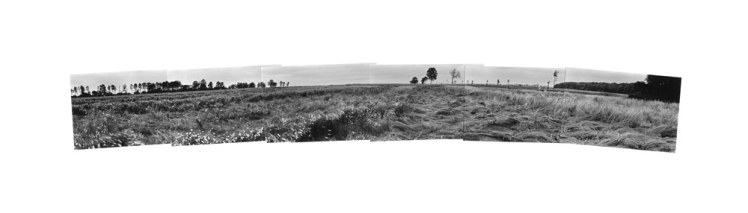
I think the differences that need to be deciphered is how we can collectively bring together text and image to create a body of work that inhibits the past and present. At this point in my work I haven’t really worked with text but I think this will be important to include as my landscapes at the moment only hold the present, abandoned buildings with no context or relation to the war.
Williams’ essays also mention the guide book ‘Before Endeavours Fade: A guide to the battlefields of the first world war by Rose E.B Coombs (I actually have this on order which I found whist researching another practitioner, so I will include a more detailed post later on) This guide book is a well illustrated guide of battle field sites which is intended for the tourist industry, like veterans, families or military enthusiasts. What is interesting is why Williams has chosen to compare these works, she says that Bright’s and Coomb’s work are in fact meant for very different audience but “they are trying to make sense, through a study of landscape, of an historical fact almost impossible to convey’ (Williams, p28,1994) Looking at these comparatively they both exactly do that, look at the typography of the landscape and deliver factual information although one is guide book and the other photographic body of work. Both still hold onto a memory from the past visually placed in the present landscape.
References
Williams, V. (1994). Warworks. London: Virago
 Critical Research Journal
One thought on “Looking at Warworks – Val Williams”