I’m not sure how I came about owning this book but from the title of ‘Structures’ it most probably caught my eye whilst researching and I am most certainly glad I did as the concepts and ideologies around structures are the closest I have found to my own work from contextual point of view, not so much a visual one.
Goldblatt says in his extensive introduction “ The photographs in this book are about the structures in South Africa which gave expression to or are evidence of some of the forces that shaped our society before the end of apartheid. Many of our structures tell much and plainly and with extraordinary clarity, not only of qualities of existence and of the needs, conceits, longings, and tears of those who built them, but often too, of vital beliefs and ideologies.” (Goldblatt, 1998) I think when you look at any structure they express the history in which the society has created it. Some may be more identifiable with a particular history and some need a little help with context but once this is applied they can be lifted from their shadows, turning from structure to heritage.
These photographs have been shot over many years and give a different type of perspective of South Africa, capturing the physical elements that lead to visual analysis of the years of the ‘Baasskap’ era a concept that refers to white supremacy in South Africa (Goldblatt, 1998). Images are shot in monochrome and are displayed with a short caption of subject with its date and also date of the photograph. At the front of the book is a detailed map, placing these structures geographically. Goldblatt explains in his book about the South African sun and how he choses to work with it instead of trying to attempt to diffuse it.
The imagery includes structures such a places of worship, houses but also documents the deconstruction and forced repositioning of communities. Artefacts and monuments are also documented which I think is an interesting inclusion when referring to my own work. These items are just as important, although the emphasis is on the structures, these items are still significant in order to portray the narrative, the artist’s intent.
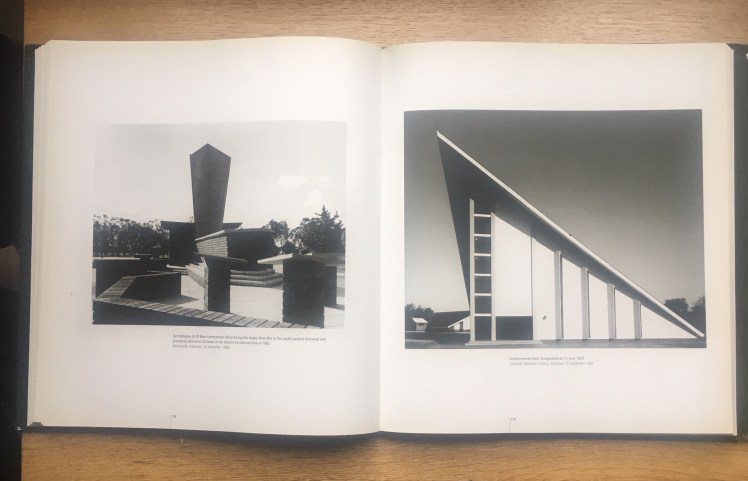
The Structure of Things Then David Goldblatt
The introduction as mentioned is extensive and gives great context into its long history and at the back are extended captions for all images that again give context to each individual structure/space and their significance. There is a lot of text so I prefer to skim over these extended captions because as knowing the history is important, I’m here for the photos and would rather hear a little more about his approach.
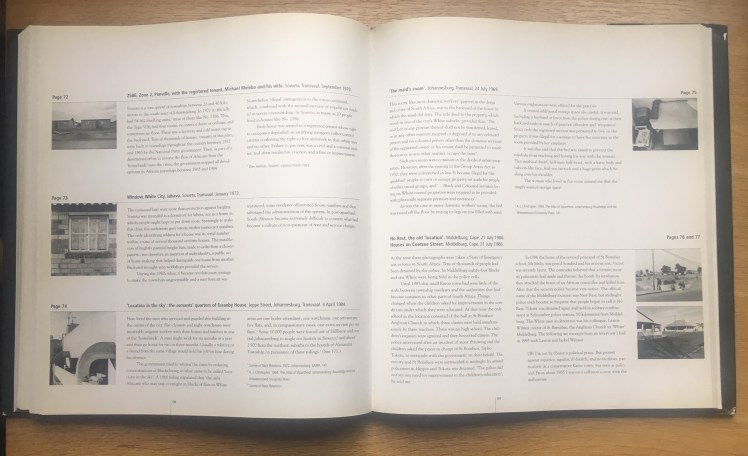
Extended captions The Structure of Things Then David Goldblatt
There is a brilliant essay by Neville Dubow ‘Constructs: Reflections on a Thinking Eye’, which I will cite some of text that I think contextualizes well into my own work. Dubow talks about an exhibition that feature many works that cover the South African apartheid era. He compares the differences of imagery, the ‘symbiotic relationship between violent events and striking imagery’ (Dubow, 1998) to Goldblatts which he says ‘these were images of a thinking kind. They were concerned with structures of a physical sort, with another kind of narrative. They spoke of another sort of violence of a more covert kind, a violence done to the social landscape.’ (Dubow, 1998) I think about the physical structure that I document and ways I can relate to the some concepts, although my work does not portray the stereotypical representation of War. I believe it asks the audience to contemplate other ideas around War and other ways it can effect societies/cultures and the implications that it has brought. As these structures are the only physical remnants of the history of WW2 they are now our heritage and should be documented.
Dubow also goes on to say “For the markings on the landscape go beyond its surface: they are testimony to the ways in which contestation over land, and what lies beneath it, has shaped the forces which have formed our landscape- its myths, its metaphors, its memories and its memorials.” (Dubow, 1998) I couldn’t agree more this statement, which I think can be applied with most places/spaces. With my work it is not just as simple as the war came, they built airfields, war is over, they left. With every airfield site, over time there will be layer of disputes, stories that come to together to make the memories for personnel and communities. This is represented in the landscape and the structures that remain and so it should be investigated and documented for now and for futures. One final quote from Dubow “ These images, then speak of interlocked dualisms- of triumphalism and loss, of possession and dispossession, of rootedness and transience, of presence and absence.” (Dubow, 1998) To remember that my work is not all about commemoration and the triumph of the military campaign from WW2 but to be mindful of other part that should also be represented if possible, looking at loss and displacement with communities.
References
Goldblatt, D. and Dubow, N. (1998). South Africa. Cape Town: Oxford University Press.
 Critical Research Journal