The global image- Photography is a fast growing medium with very few people who don’t have access to it on a daily basis, with advertising and social media it is certainly becoming a popular tool throughout the world.
How did it start, how did it become so popular? These were some of the questions discussed in this week’s presentation.
Presentation 3: Unity and Change
“Photographs are popularly believed to have the power to elicit change on a world-wide scale. The realism of the photographic image both moving and still are unparalleled in its apparent accuracy compared to other forms of reportage, cross cultural boundaries and communicates within immediacy that is often hard to ignore.”
–Tutor transcript
I believe that there is strong case for photographs to be used as powerful tool to bring about change, we can see so many examples through history that this is seen.
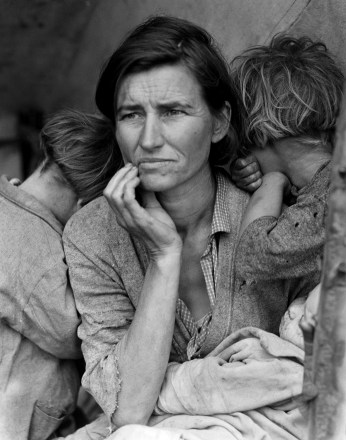
The Migrant Woman, 1936 Dorothea Lange
This image was taken at the height of the great depression. A mother of 7 at a camp for seasonal agricultural workers, she struggles to provide food for her starving family. Several images reached the American government and as a result a large shipment of food was sent to feed the camp.
I think global images will only increase with the growing number of people who have access to the Internet and social media. With this being said there is an increased amount of content, which can make it difficult to filter, and for it to reach the right audience. In my practice social media has greatly improved chances of hitting globally rather than just locally or UK.
Reflection
The biggest challenges this first week, have been getting back into the habit of talking about my work critically. In my practice I am normally given a brief from the customer, I rarely give much thought how I get to the end product but just fulfill the brief/task. I got a lot from the webinar and talking with my peers from different backgrounds, made me really think about the global image in different perspectives, the collaborative aspects and if that constitutes to a global image.
Week 2
Interdisciplinary Approaches – focusing on what is meant by interdisciplinary approaches in photography.
Presentation 1: Photography, Time and Motion
“In this presentation we will discuss the still photography and the moving image, two mediums with as many differences as similarities. On a practical and critical level it is relevant to consider the rapidly changing relationship between still and moving images but we shall see also how discussing two distinct disciplines side by side reveals aspects of their fundamental nature .”
-Tutor transcript
With the change of technology the moving image is becoming more accessible to professionals and non-professionals to develop a new discipline. With one single device/camera you can switch from stills to video with just a touch of a button. These cameras come in at all price points and with varying platforms to export your work. As I practitioner though is it as simple as switching a button to capture a good video piece?
As a practitioner in my field we hold the title of photographer and videographer, with the main emphasis being on stills. We receive very little training on video but often expected to produce the same high quality of work. For the non-professional there are many apps and software that can make the editing easier.
I feel to make a decent video package you have to work harder to produce these series of images, looking for cutaways or keeping correct screen direction I feel with video there is certainly no room for poor exposure or out of focus frames. Then with editing there are lots of different things to consider.
Reflection
This week was very interesting looking at my peers interpretation of interdisciplinary disciplines. Some featured poems, artists and genres in films and that really got me thinking about different disciplines. I struggled at first to find anything that could relate to my practice that wasn’t photography, so researching different medium was new to me.
 Critical Research Journal