I ordered this book after viewing the Mark Klett and Byron Wolfe lecture at the Falmouth Face 2 Face event. I wanted to view this body of work in its publication form as to get a feel for the project in its entirety.
Yosemite is a place that sees many passes by, this site has been recorded as part of one of the first U.S geographical surveys and is classed as a top tourist destination in America. Many stop to record it either in the form of a sketch, painting or photograph, in the introduction by Rebecca Solnit it says “The pictures Mark and Byron made for this project measure the difference between photographic vision and also measure changes in the landscape. I was measuring the radical changes in ideas about the place.” (Solnit, 2005)
Solnit also goes on to describe how photographers such as Timothy O’Sullivan, William Henry Jackson, William Bell and Andrew J. Russell, among others had explored, mapped, studied and photographed the West. In particularly the Rockies and dessert regions as part in the U.S Geological Surveys of 1860-1870s. (Solnit, 2005)
The first images that feature in the book are a direct comparison from historic source imagery to the ‘now’, featuring the image on the left from the 1865-1944 and then on the right 2001-2003. For me I like to see the comparison, how the landscape alters and shifts, it is important that the same viewpoint is used. Using this technique is an effective way to quickly demonstrate the connection of time periods projected onto the landscape. In which discussion can be held about how these landscape’s perceptions and representations have/can be altered.
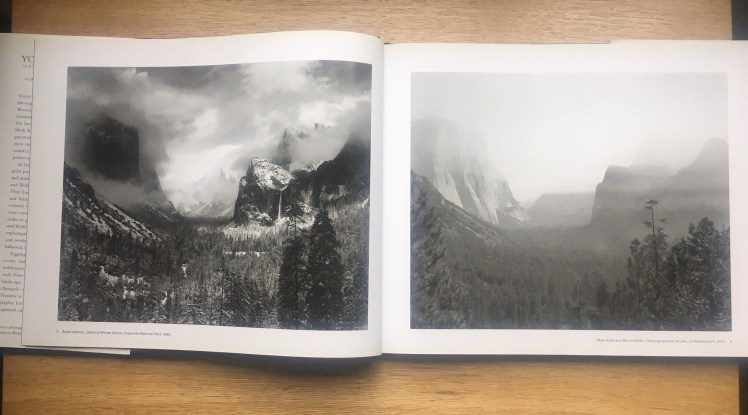
Yosemite In Time by Klett and Wolfe.
The next section goes into Ghost River and a essay by Solnit, there she discuss’ rephotography and its different metaphors, which to be honest I get a bit lost as she goes into different concepts of it. This part I found this quite interesting though as I hadn’t really thought about it “the technique of rephotography also reveals about the initial photographer’s sensibility, interpretations and decisions. When you return to the site of a photograph, you return to the site of creative decisions about what to include and exclude.” (Solnit, 2005)
Images that follow, are of a constructed panoramic that feature an image by O’Sullivan that has been layered within their imagery. This is an interesting play using rephotography but in creative way, increasing the view from the original photographer’s projection. I also enjoy the image where they isolate 18 trees and put them side by side showing 131 years difference.


Yosemite In Time by Klett and Wolfe
Another type of comparison features the original viewpoint and in the adjacent photograph the ‘old’ has been defined by a rectangle border around it, which gives the viewer the original photographers view and then the extended. These images are intertwined with standard before and after rephotogtaphy (well of course not so standard). Visually, all images are stunning and are a mixture of monochrome and colour. The text is detailed and describes their journey as a collaborative group, how they move from site to site. I like this personal journey of photography through Yosemite but for me it was a bit rich and I had to skip over some it.
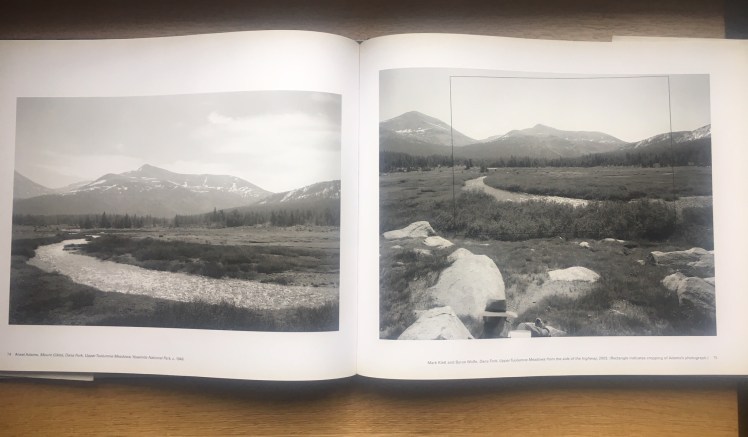
Yosemite In Time by Klett and Wolfe
The publication is laid out well and combines different styles of rephotography as mentioned with arranged pull out panoramas. I like this approach as it shows rephotography in a different perspective, combining the original photographers vision with the new, a collaboration. This approach would be useful to experiment within my own work as I think this could be an interesting aspect, showing different types of infrastructure and their journey through time- if only I had the archive to work with!
References
Klett, M., Wolfe, B. and Solnit, R. (2005). Yosemite in Time. 1st ed. Texas: Trinity University Press.

